
Botetourt Jail VINE Coverage
Virginia Jail VINE is the custody-search and notification route for participating local and regional jails. The Botetourt Sheriff's victim-notification page directs users to VINELink for the Botetourt-Craig Regional Jail and describes access through the website or mobile option. Telephone service is available at 1-800-467-4943, and the Virginia brochure lists TTY service at 1-866-847-1298. The service is free, anonymous, and available at all hours.
VINE reports the status supplied for a particular jail custody record. It can support notice of release, transfer, death, escape or return, and other facility-dependent events. It is not Botetourt's recent-release feed. The sheriff does not publish an official current roster or rolling release list, and the promoted VINELink app is not a sheriff mugshot gallery.
The distinction becomes critical after a transfer. A person who leaves the regional jail for VADOC, ICE, another jail, or federal custody has ended the local event but may remain confined. VINELink's released label cannot be expanded into a claim of community freedom without checking the destination.
Botetourt uses two names for the same adult facility: Botetourt-Craig Regional Jail and Botetourt County Jail. A result carrying either local naming style should be matched through its location and identifiers rather than treated as proof of two separate jail records. The sheriff manages the facility, while VINE supplies the notification interface.
Search One Botetourt Jail Record
Use the Virginia VINELink person search for one specific person. Begin with the name or an offered identifier. A broad name may return more than one match, so the result must be compared with the reporting facility and any available age, birth date, or identifier. Never treat the first similar name as the right person.
- Open the Virginia person-search entry point and choose the custody or offender search presented by the interface.
- Enter the first and last name, or use the offered identifier when it is known. Check spelling and aliases if no result appears.
- Open the likely record only after comparing identity details and the facility. Look for Botetourt-Craig Regional Jail when checking that local custody event.
- Read the displayed status as the reporting jail's status. Note whether the event says custody, release, or transfer.
- If the local event ended, check the court and the possible receiving system before concluding the person returned to the community.
The successful manifest capture below comes from the official Virginia person-search entry point.
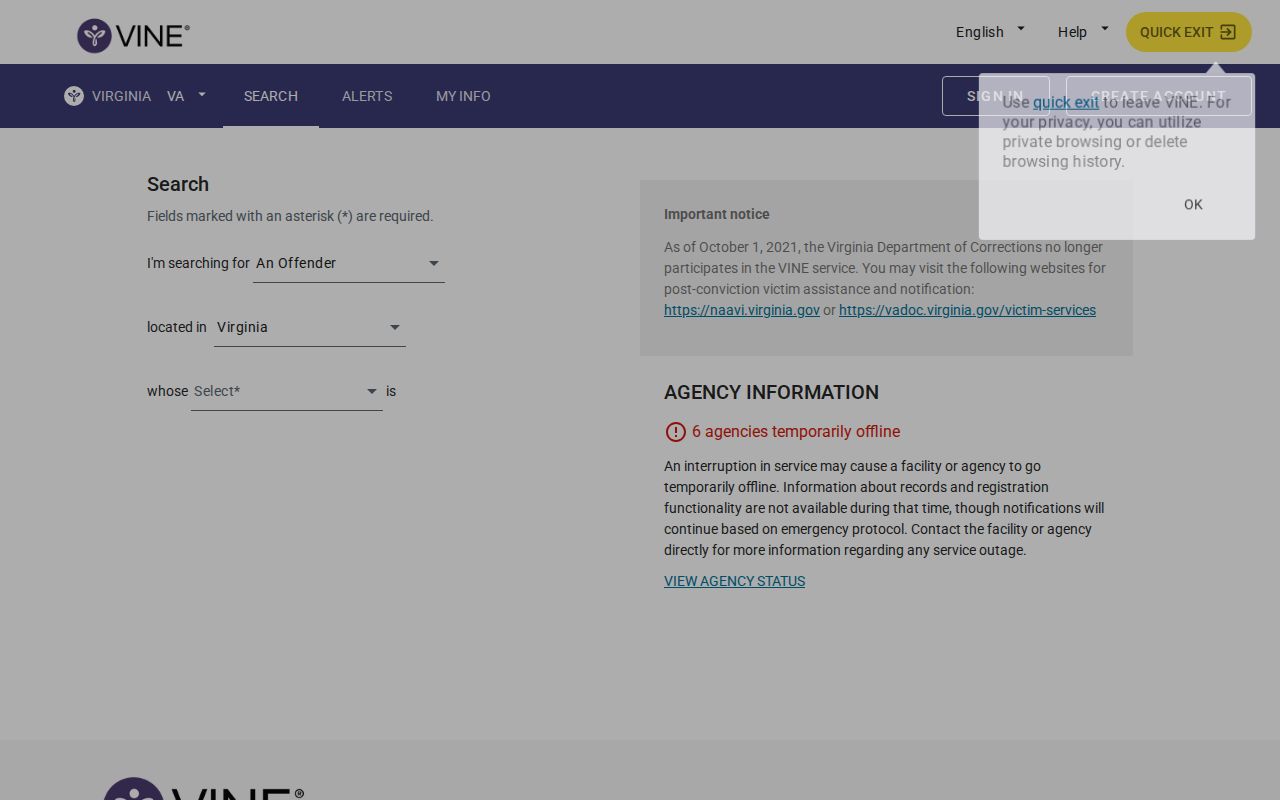
The interface is useful for matching one person and opening notification options. It does not establish an official 24-hour or 72-hour release window.
If VINELink yields no match, try a spelling variant, allow for reporting delay, and call the holding jail. The absence may reflect a transfer or an ended visible record. For a full custody-type decision path, use the Botetourt County released inmate lookup.
A court search can add context without replacing the jail status. Botetourt General District Court handles lower-court criminal matters and felony preliminary stages, while Circuit Court handles felony trials and appeals. One custody event can touch two case numbers. Record the case number, disposition, sentence, and appeal before asking the jail to identify the matching release entry.
Botetourt VINELink Release Fields
Exact fields can vary by participating facility. The verified research supports identity, reporting facility, custody status, and event notices rather than a fixed local release-record schema. A durable release record with exact time, type, or destination comes from the sheriff, not from assumptions about the VINE screen.
| Field or event | What it can establish |
|---|---|
| Identity details | Helps separate people with similar names when matched with available identifiers. |
| Reporting facility | Shows which participating jail supplied the custody record. |
| Custody status | Describes the state of that jail event, subject to agency reporting and update limits. |
| Release notice | Reports that the local custody event ended, not necessarily that all custody ended. |
| Transfer notice | Signals movement from the reporting jail and calls for a destination-system check. |
| Other event | May include death, escape or return, or another event supported by the facility. |
Advance notice is not universal among jails. Virginia's official workflow says to call the facility for release information when advance notice is needed. Once VINE reports the release, notifications for that custody event stop.
Note: A released VINE result confirms the reporting event ended, while the sheriff release entry can document exact time and destination.
Register for Botetourt Release Alerts
Registration begins from the matched individual record, not from a countywide list. Choose the channels that the current interface offers. Virginia materials describe phone, text, email, TTY, and app options where supported. Keep contact data current because a missed or blocked message can defeat the purpose of an alert.
- Confirm the name, identifiers, and reporting facility on the selected VINELink record.
- Choose the notification option and select each supported channel that fits the need.
- Enter the telephone number, text number, email address, TTY route, or app details requested by the service.
- Create a private PIN for telephone calls. Do not post or share it.
- When VINE calls, enter the PIN to acknowledge the notice and stop repeat calls for that event.
- Update changed contact information and register again when the system instructs after a custody-system transfer.
Registration does not guarantee a warning before the release. It does create a route for the facility-supported events that are reported. A family member, victim, or other permitted user should still keep the holding agency's contact available for time-sensitive confirmation.
Telephone acknowledgment matters. Entering the private PIN tells the system that the event notice was received and stops repeat calls for that event. It does not close a text or email account, certify that the recipient understood the event, or enroll the user in a new custodian's system. Review the matched status after each message.
Botetourt VINE to VADOC Handoff
Botetourt's sheriff gives an unusually clear local warning: VADOC stopped participating in VINE on October 1, 2021. That means Jail VINE, the VADOC public locator, and VADOC's NAAVI notification service cannot be treated as one account or one continuous record.
Use Virginia Jail VINE for the Botetourt-Craig Regional Jail. If the person transfers into state custody or remains in a local bed under VADOC authority, use the VADOC Inmate and Supervisee Locator for general custody or supervision status. The locator accepts a seven-digit DOC ID or a name search and says it updates daily. It is not a guaranteed historical index after full discharge.
NAAVI is the state victim-notification route for qualifying users. Current VADOC material says its events can include transfer, anticipated release usually about 30 days ahead, actual release, death, work release, escape or return, and parole events. The VADOC notifications page gives the current enrollment route and Victim Services contact. NAAVI is not an unrestricted public supervisee search.
VADOC Victim Services lists 1-800-560-4292 and victimservices@vadoc.virginia.gov, with posted weekday hours of 8:30 a.m. to 5:00 p.m. Those contacts belong to the state-notification channel. The local Jail VINE number remains the correct telephone route for a Botetourt-Craig jail registration.
The sheriff's official VINE page is shown in the matched research capture.
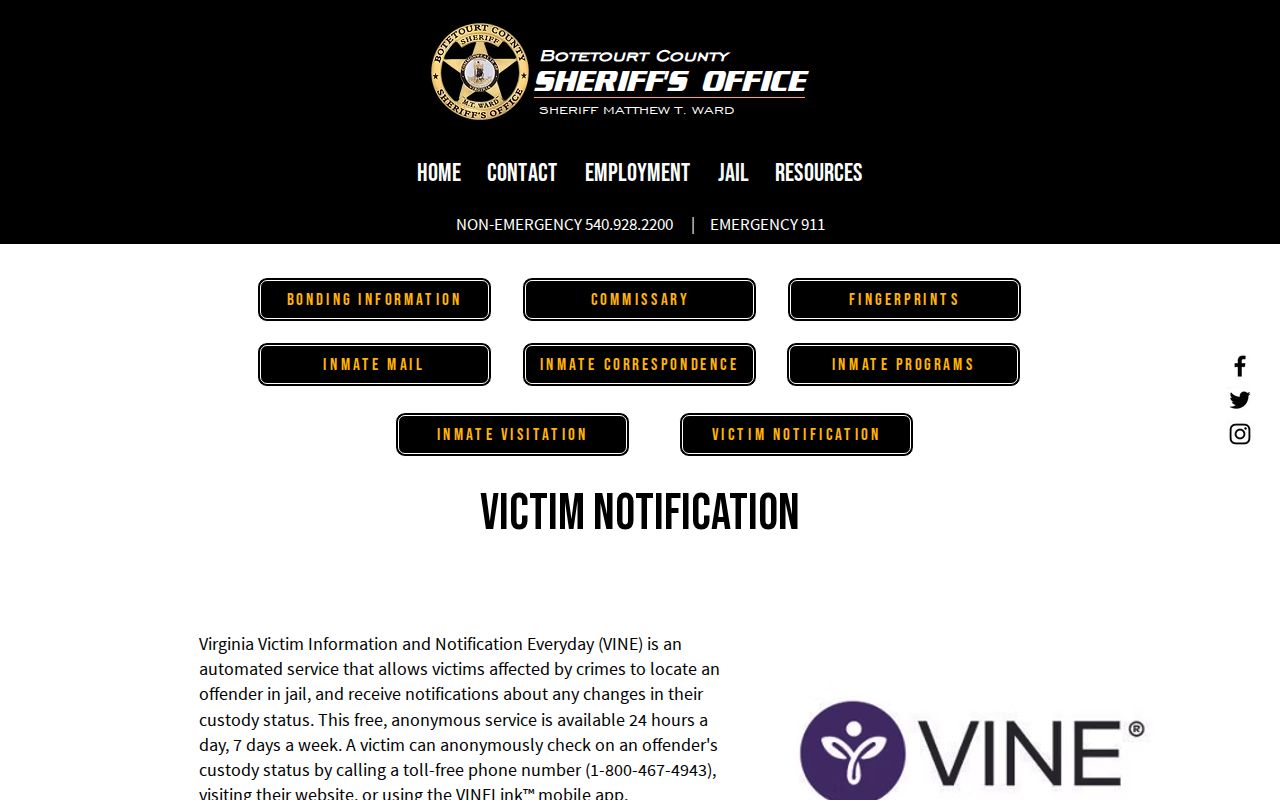
The local notice anchors the three-channel split and helps prevent a registration gap when custody shifts.
Confirm a Botetourt VINE Release
VINELink has several firm limits. It does not cover a sentenced federal prisoner's BOP record, and it is not the source for a federal pretrial release order. It also does not replace ICE ODLS after a jail-to-ICE transfer. Within the local system, data can lag and fields depend on the reporting jail. A name that is missing or a record that is inactive is not proof of release.
For the Botetourt-Craig Regional Jail, call the 24-hour line at 540-928-2314. Ask whether the person remains there and, if not, whether staff can confirm that the event was community release or transfer. The county directory also lists 540-473-8230 for the jail. Record which official number supplied the answer.
Then match the legal and destination records. A Botetourt court docket can show bond or disposition but may not show the exact physical release time. A sheriff booking-and-release record can supply existing fields for admission, release date and time, type, and destination. If VADOC is plausible, search its locator. If ICE is plausible, use ODLS promptly. For federal custody, use the BOP locator or the federal court and holding facility as the case requires.
A focused sheriff request should identify the full name, narrow admission date range, and booking number if known. Ask for existing release date and time, release type, and destination or receiving agency. That request seeks a durable agency record. It does not ask VINE to preserve a finished notification history or require the sheriff to create a new report.
Federal and immigration checks should also stay distinct. A sentenced federal prisoner is searched in the BOP locator, whose released and not-in-BOP-custody labels do not exclude other confinement. A possible immigration transfer belongs in ICE ODLS, which includes current detainees and people released from ICE custody within the prior 60 days. Neither system is part of the local VINELink registration. A federal pretrial release is best confirmed through the federal court order and holding facility because the U.S. Marshals Service has no comparable public historical release locator.
For an old Botetourt event, the cumulative booking and release record is more durable than a live alert. Virginia's GS-08 schedule retains that record series for 20 years after separation. Retention does not guarantee public web access or disclosure of every field, but it explains why a precise sheriff request can still work after the VINELink event has ended.
Note: After a local VINE release event, updates stop and a new registration may be needed in the next system.