
Botetourt Forecast Versus Release
“Projected Release Date” is the exact public field label documented in Virginia's official offender presentation. It is an administrative forecast based on the sentence structure, jail credit, and the earned-credit assumptions that apply at the time of calculation. It is not an appointment, a court order, or proof that release took place.
The actual release date is the executed event recorded by the custodian. VADOC says a person who satisfies a state sentence is discharged or released on parole, receives a notification-of-release letter, and signs the applicable Order of Release, Conditions of Probation, or Conditions of Parole. State discharge or parole release occurs by 11:59 p.m. on that date, weather permitting. That published state rule does not establish the Botetourt-Craig Regional Jail's local release hour.
Pretrial custody has another shape. A person awaiting a Botetourt court date does not have a sentence-based release date. Release may turn on recognizance, unsecured or secured bond, a court order, dismissal, or another hold. The court docket can explain the legal event, while the jail record establishes when physical custody ended.
- Court sentence
- The legal term imposed, including active and suspended portions.
- Projected release date
- The custodian's current administrative forecast based on the governing computation.
- Parole eligibility date
- A date when a legally eligible case may be considered, not a promised grant.
- Actual release date
- The date the custodian executed the custody exit.
- Final discharge
- The later end of custody and, depending on the record, correctional supervision obligations.
Find a Botetourt Release Forecast
The correct channel depends on who computes the active term. VADOC handles an active state sentence longer than 12 months and certain people under its authority in local beds. The regional jail applies its written policy to a qualifying local sentence. The sentencing court supplies the starting legal terms but does not continuously update earned credits or disciplinary changes.
- Identify whether the person is pretrial, serving a local sentence, or serving an active VADOC sentence. Use the Botetourt court case and the holding facility to resolve that first.
- For state custody, open the VADOC Inmate and Supervisee Locator. Search by seven-digit DOC ID or by the first three letters of the first name and full last name.
- Compare identity and location before reading the Projected Release Date. A district-office result can mean community supervision rather than current prison custody.
- For a Botetourt local sentence, ask the Botetourt-Craig Regional Jail for the current computation or release record. Use 540-928-2314 for its 24-hour information line.
- For a pretrial case, read the court's bond and detention orders. Do not create a date from the sentence-credit rules.
- Confirm the later event with signed release papers or the custodian's actual release entry.
The official public example captured in the manifest displays the Virginia “Projected Release Date” field.
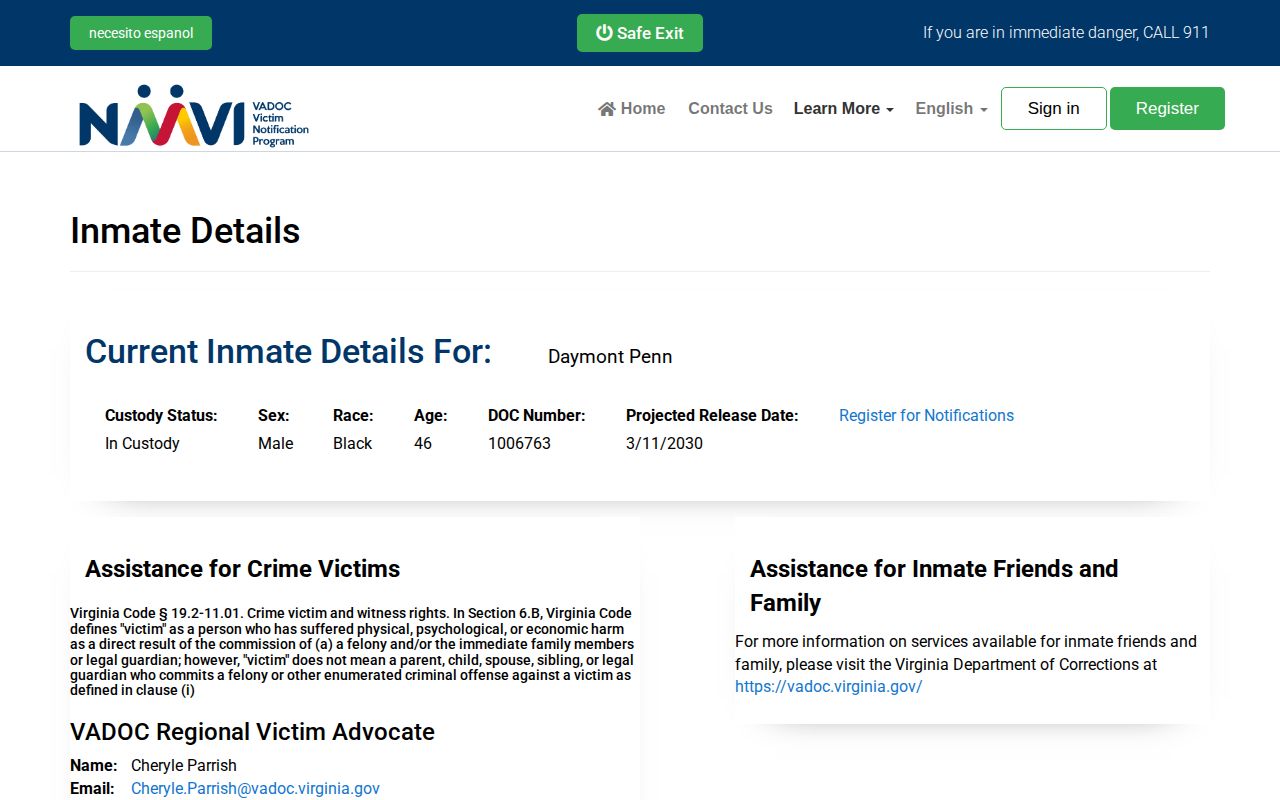
The example confirms the field label and presentation. It does not make one person's forecast a rule for another sentence.
The Botetourt County release search supplies the broader custody decision path when the responsible agency is unclear.
Note: VADOC customer-service policy permits confirmation of a projected release date at inquiry, subject to disclosure rules.
Virginia State Release Computation
VADOC's Time Computation page separates Good Conduct Allowance from Earned Sentence Credits by offense and sentence dates. Good Conduct Allowance applies principally to parole-eligible felonies committed before January 1, 1995 and misdemeanors committed before July 1, 2008. For a qualifying active sentence longer than 12 months, VADOC computes parole eligibility, mandatory parole release, and good-time release. GCA earning classes range from zero to 30 days for each 30 served.
Earned Sentence Credits apply to felony offenses committed on or after January 1, 1995. Under Virginia Code § 53.1-202.3, listed offenses earn no more than 4.5 credits per 30 days served. That limit supports the common shorthand that a post-1995 felony prisoner serves roughly 85 percent, but the phrase is not a universal calculation.
For other eligible offenses under the statute, Level I earns 15 days per 30, Level II earns 7.5, Level III earns 3.5, and Level IV earns zero. Classification depends on conduct and program requirements and is reviewed at least annually. Credits do not reduce the period required before parole eligibility.
The matched VADOC time-computation capture shows the official source for these distinct regimes.
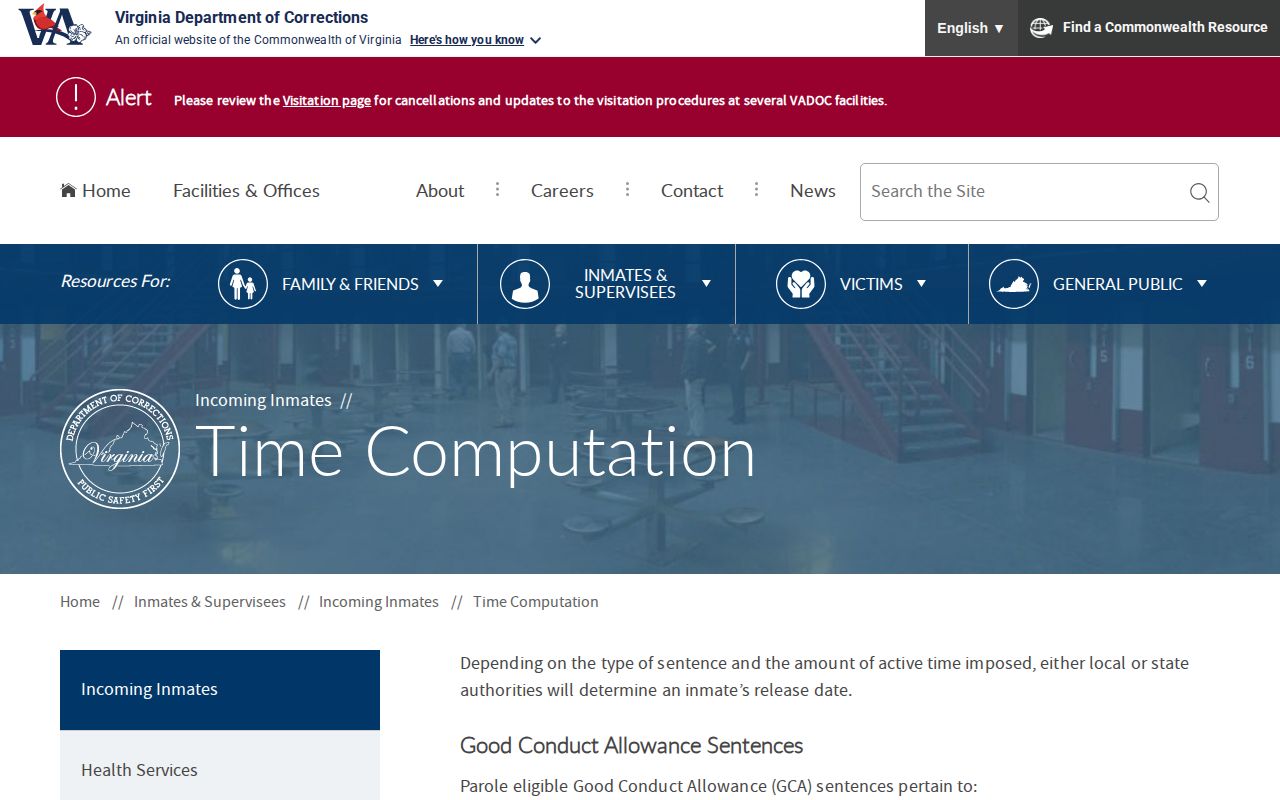
The source should be paired with the live statute because eligibility and rates depend on the specific offense and date.
Botetourt Local Jail Computation
A short local sentence is not calculated by copying the VADOC state-prison display. Virginia Code § 53.1-116 governs the jailer's records and written policy. Unless serving a mandatory minimum, a prisoner sentenced to 12 months or less for a misdemeanor or combination of misdemeanors earns one day of good-conduct credit for each compliant day served, including qualifying presentence confinement.
The same section provides 15 days per 30 for a parole-eligible prisoner with satisfactory conduct. A jailer may award up to five more days per 30 for qualifying work assignments, classes, or a local workforce program if the option exists in the written policy. Rule violations can add credited time back. A post-January 1, 1995 felony prisoner held in a jail remains subject to the state Article 4 limits.
This local channel has no verified Botetourt online calculator. Ask the regional jail for the active computation or an existing record. If a field is coded, request the existing legend. Do not divide the pronounced sentence in half, subtract an assumed rate, or import a policy from another Virginia jail.
Why Botetourt Release Dates Move
A projection changes when one of its inputs changes. Some causes are administrative, such as a corrected jail-credit entry. Others are legal, such as a new sentence or appellate order. The public date should always be read with its current custody status and source date.
| Factor | Effect on the forecast | Record to check |
|---|---|---|
| Conduct or class change | Credits may accrue at a different rate or be forfeited. | VADOC or jail computation record |
| Presentence credit correction | Credited time can be added, removed, or reconciled. | Court order and custodian computation |
| New or consecutive sentence | The combined active term can move the expected end date. | Signed sentencing orders |
| Detainer or hold | The person may leave one custodian but enter another rather than the community. | Release entry and receiving-agency record |
| Appeal or amended order | A court can change the legal basis used for computation. | Current court order |
| Parole decision | An eligible case may be granted, denied, or deferred, but a grant still requires execution. | Board decision plus VADOC release papers |
| Administrative correction | An identified data or sentence-computation error can change the field. | VADOC or jail response |
A detainer is a request or legal basis for another authority to take or continue custody. It explains why a person may reach the forecast date, leave VADOC or the regional jail, and still not enter the community. Always check the destination field or transfer entry when one is maintained.
Note: A parole Grant is a decision milestone, while certification, planning, detainer review, and physical release remain separate steps.
Botetourt Parole Dates Differ
A parole eligibility or review date answers when a legally eligible case may be considered. It does not promise a hearing on a public calendar, a Grant, or release. Virginia generally abolished discretionary parole for felony offenses committed on or after January 1, 1995 under § 53.1-165.1, while specified exceptions remain.
For older eligible sentences, § 53.1-151 provides baseline fractions and caps, along with extensive exclusions. A first commitment, later commitment, life sentence, violent-repeat provision, juvenile-offense route, and geriatric route cannot be reduced to one formula. Use the offense date and case type, then rely on the Board and VADOC calculation.
A monthly Board report can show Grant or Not Grant, decision and certification dates, and case details. Even a Grant is not the actual release record. The physical event follows VADOC processing and may be affected by detainers.
Confirm Botetourt Actual Release
For a local jail event, call the Botetourt-Craig Regional Jail and request the existing booking-and-release entry when exact proof is needed. Ask for release date and time, release type, booking number, and destination or receiving agency if those fields are maintained. A court disposition helps explain the legal basis but may not record the actual exit time.
Use both Botetourt court levels when the case path requires it. General District Court handles lower-court criminal matters and felony preliminary stages. Circuit Court handles felony trials and district-court appeals. A custody event can therefore touch two case numbers, and the signed Circuit Court order may contain the final active and suspended terms that begin the release calculation. Juvenile matters stay in separate confidential channels and are not part of this adult date lookup.
For a state sentence, compare the current VADOC status with the notification-of-release letter and signed release or conditions documents. A supervisee entry can show that incarceration ended while parole or probation continues. No locator result does not prove full discharge because VADOC does not promise a permanent historical index of every discharged person.
Virginia Jail VINE can send an event notice for the regional jail, but advance notice is not universal. Registration ends after the reported release and may not follow a person across systems. The Botetourt VINELink release check explains the local registration and the separate VADOC NAAVI route.
The strongest answer is a chain: court terms, current computation, actual custodian release entry, destination-system check, and supervision status. That chain preserves the difference between a forecast and what finally occurred.
Virginia FOIA can be used to request an existing releasable record, but it does not require an agency to create a fresh computation or answer why a date moved. A precise VADOC request can identify projected and actual release information, custody status on a given date, and a particular release document. A sheriff request can identify the Botetourt booking and release entry. Ask for electronic records in their existing format and a cost estimate before work begins.
When a release leads to parole or probation, the correctional event is complete but supervision is not. District 40 in Fincastle is the VADOC adult supervision office for Botetourt. A district-office result in the state locator can therefore corroborate community supervision after the prison date passes, while the signed conditions state the governing terms.