
BOP and USMS Record Boundaries
BOP and USMS records answer different federal custody questions. BOP's locator is suited to a sentenced federal prisoner and usually covers federal inmates from 1982 forward. It can display a Release Date, Location, and labels such as Released, Not in BOP Custody, or In Transit. USMS, by contrast, manages federal prisoners from arrest or remand until release, acquittal, or delivery to BOP and often uses beds operated by other agencies.
A pretrial defendant can leave a local holding facility under a federal court order without ever creating the same type of BOP locator history as a sentenced prisoner. Confirm that event with the signed release or detention order and the facility that held the person. USMS has no comparable public historical release locator, and it does not publish arrival or departure times or prisoner photographs as public custody details.
For an older or unclear federal event, build the request around the correct custodian. Use the register number and BOP record route for sentenced custody. Use the federal district, case number, person, and narrow date range for a USMS FOIA request. Ask for existing records rather than an explanation or a newly compiled history. A local facility may hold its own movement entry, but it cannot replace the federal court order or certify a later BOP release.
Note: A BOP no-custody label cannot substitute for a USMS record, federal court order, or receiving-facility confirmation.
BOP Federal Release Interface
The official BOP locator presents the register-number and name search used for federal sentenced custody.
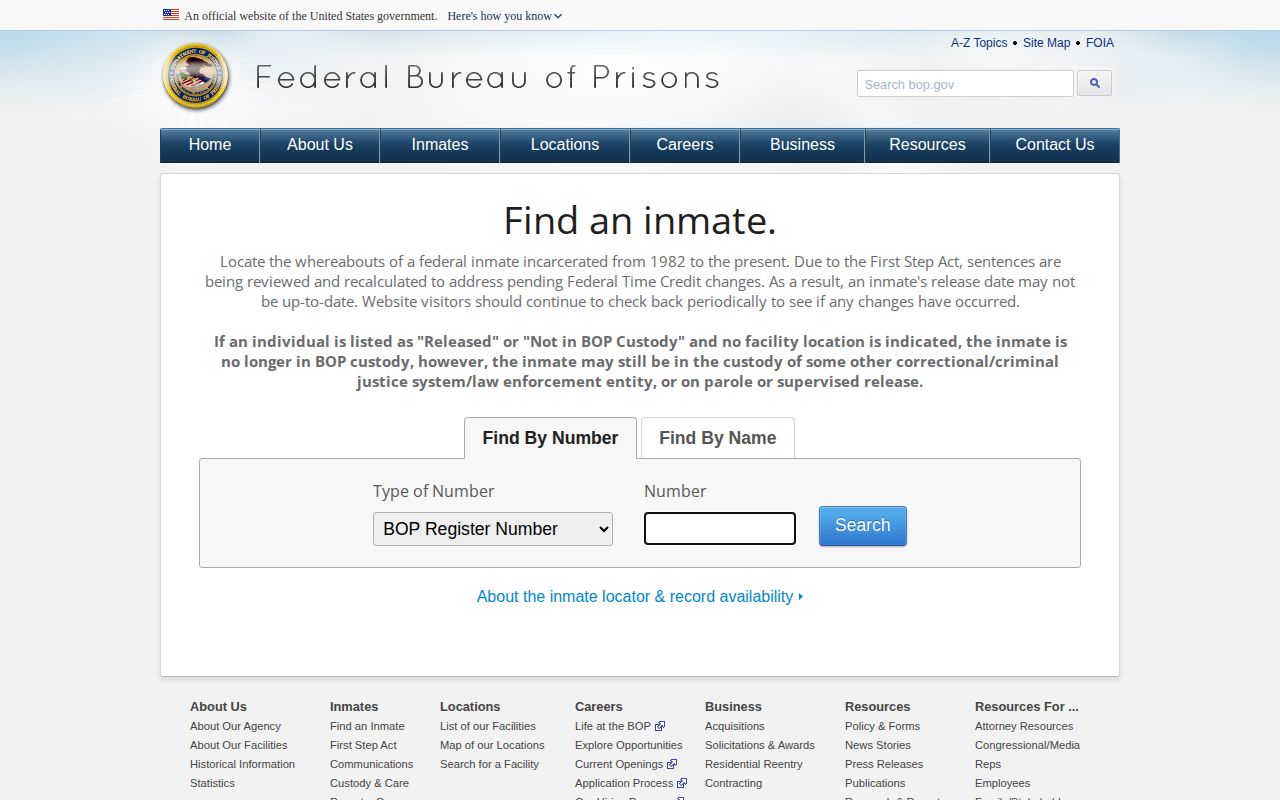
The interface documents the lookup route, but a returned status must still be read with the federal court record and any other custodian.
Botetourt Federal Custody Routes
The federal system has two distinct paths relevant to Botetourt County. BOP handles federal prison sentences and publishes an inmate locator. USMS manages federal prisoners from arrest or remand until acquittal or release, or until delivery to BOP. USMS frequently uses beds operated by other public or private custodians and has no comparable public historical release locator.
A person can therefore be physically housed in a regional jail without being an ordinary Botetourt local detainee. The legal custodian, federal case, and holding arrangement control the release route. A county jail status may confirm that the local building stopped holding the person, but the federal order or receiving system explains whether the person entered the community, moved to BOP, or transferred elsewhere.
| Federal stage | Primary record | What confirms release |
|---|---|---|
| Federal pretrial or remand | Federal docket and detention or release order | Court order plus holding-facility confirmation |
| USMS transport | USMS and facility records | Receiving custodian, not a missing local result |
| Federal sentence | BOP locator and BOP record | Past Release Date and Released status, checked for other custody |
| Supervised release | Federal court judgment and probation records | Custody ended while court-ordered supervision continues |
Search BOP Release Records
Use the official BOP Inmate Locator for a person who served or may be serving a federal prison sentence. A register number is the best identifier. Name searches also allow demographic filters. Compare the returned register number, name, age, race, and sex before reading location and date fields.
- Search by federal register number when it is known.
- If using a name, add only enough demographic filters to identify the right person.
- Review the Location and Release Date fields together.
- Distinguish a past release date from a future projected date.
- Check the court and any other custodian before equating BOP release with freedom from all control.
BOP records generally cover federal inmates released from 1982 onward. Older cases may require National Archives research. The locator is not the first tool for a routine Botetourt-Craig Regional Jail booking, a Virginia sentence, or immigration custody. Use it only when the federal prison path is supported by the case.
Note: BOP warns that release data can change, including when sentence calculations are revised under federal law.
Read Federal Release Status
BOP's record explanation gives critical context for its labels. A past release date with no facility and a status of "Released" indicates the person is no longer in BOP custody. "Not in BOP Custody" also has a narrow meaning. The person may be held by another law-enforcement or corrections system or may be on parole or supervised release.
| BOP result | Safe interpretation |
|---|---|
| Released | The recorded BOP custody event ended. |
| Not in BOP Custody | BOP is not the current custodian; another custodian or supervision remains possible. |
| In Transit | The person is moving within custody, not released. |
| Future Release Date | A projected date that may change. |
| Past Release Date | A historical BOP exit that still needs a destination and supervision check. |
The strongest record chain uses the BOP result, the federal judgment, the actual release record when available, and any supervised-release terms. A state, local, or ICE locator may be needed when the federal record suggests another custodian.
Confirm USMS Release
The U.S. Marshals Service custody program covers federal defendants from arrest or remand through acquittal, release, or delivery to BOP. Because the agency uses federal, state, local, and private facilities, a person may move without appearing in a single public USMS locator. For a pretrial release, use the signed federal court order and confirm with the holding facility.
Search the federal docket by case and district. Identify the release or detention order, hearing date, and any later order changing conditions. Then contact the facility that actually held the person. Ask whether its custody ended and whether the record identifies a transfer. Do not ask a local jail to interpret a federal judge's order, and do not assume a docket entry states the exact physical departure time.
USMS does not publish public details such as prisoner photographs or arrival and departure times. That limitation is not proof that the event did not occur. It directs the request toward existing agency or facility records and the court order.
Federal Release Record Requests
A USMS FOIA request can identify an existing record by full name, date range, federal judicial district or case number, and desired format. Submit through the agency's Public Access Link or address the Office of General Counsel FOIA Unit. Clearly mark it as a FOIA request. The agency need not research a question, explain why a person moved, or create a new record, and exemptions may limit disclosure.
U.S. Marshals ServiceOffice of General Counsel, FOIA Unit
CG-3, 15th Floor
Washington, DC 20530-0001
Official FOIA information
For BOP records, identify the person by register number and request the precise release or custody fact needed through the proper BOP record channel. For a local holding event, the local facility may have its own entry. Requests should stay within each custodian's role. One agency is not required to supply another system's record.
- Remand
- A court order placing a federal defendant in custody while the case proceeds.
- Register number
- The federal identifier used to match a person in BOP records.
- Supervised release
- A court-ordered period in the community after prison, distinct from BOP confinement.
- Transfer
- A move between custodians or facilities rather than release to the community.
Note: Ask for existing records by person, case, dates, and format rather than asking the agency to explain the whole case.
Botetourt Federal Release Checks
No federal prison was identified in Botetourt County through the official sources reviewed. That does not make federal custody irrelevant. A person tied to Botetourt can be arrested on a federal matter, held outside the county, temporarily placed in a local contracted bed, moved by USMS, and later delivered to BOP. Geography alone cannot select the right locator.
Begin with the charging court and sentence type. If the federal case is pretrial, prioritize the federal order and holding facility. If a prison sentence was imposed, use BOP. If the local jail entry shows an agency transfer, follow the named destination. If immigration custody is possible after a release, use the separate ICE route promptly.
The broader Botetourt County release record search is for joining state, local, federal, and court sources. Do not replace a federal check with the county's absent recent-release page. Botetourt publishes no official 24-hour or 72-hour list, and such a list would not be a complete federal record even if one existed.
Federal Release and Supervision
Physical release from BOP can begin supervised release under the federal judgment. That is not Virginia parole or VADOC District 40 supervision. The federal court's order states the term and conditions, while the responsible federal supervision office handles the case. A BOP locator status cannot show every later court event.
Match four dates when possible: sentencing, projected federal release, actual BOP release, and the end of supervised release. A detainer or another sentence can add another custody event. If the person is received by a state, local, or immigration custodian, record that handoff separately. This timeline avoids treating one system's end date as the end of all legal control.
Note: A federal prison release and completion of federal supervised release are separate events documented by different records.
Public Record Search
Sponsored Results