
Botetourt 72 Hour Release Window
The Botetourt County Sheriff's site and official page sitemap were checked separately for a 72-hour view on August 8, 2026. No current roster, released view, or three-day release URL was found. The absence is specific. It is not a hidden filter on a known feed, and it does not justify assigning another county's update cycle to Botetourt. No verified web fields, expiry rule, booking-photo behavior, or weekend refresh schedule exists.
A three-day check still has value. It creates a practical date boundary for jail staff, VINE events, court hearings, and a written request. It can capture several release paths that may have occurred while an office was closed, but it must preserve the difference between a local custody exit and community freedom.
Check Botetourt Three-Day Releases
Use the same start and end dates throughout the process. A fixed three-day range keeps court events, jail entries, and notification records aligned. For events still unfolding today, the Botetourt releases from the last 24 hours page prioritizes immediate custody confirmation.
- Set the exact range. Write the beginning and ending date, and include approximate times if they matter.
- Call the regional jail. Use the number on the official sheriff jail page and ask whether the named adult remains held. If not, ask whether the departure was a release or transfer.
- Review Jail VINE events. Use the Botetourt victim-notification route, search the specific person, and match the reporting facility. A release or transfer notice describes the end of that participating-jail event.
- Match the court record. Look for bond, dismissal, sentencing, time-served, or transfer-related proceedings during the same date span.
- Request the durable entry. Send the sheriff a focused request for existing booking-and-release fields covering the person and three-day range.
When the jail reports a transfer, follow that destination. VADOC covers state custody and supervision. ICE ODLS and BOP serve different federal roles. A local VINE registration may also end when the person crosses into a new system.
Note: Fix the date range before searching so records from adjacent days do not distort the three-day custody sequence.
Botetourt Three-Day Record Fields
No official online list supplies these fields. Instead, request them from the sheriff's existing booking-and-release record for the date span. A precise field list helps the custodian locate the record without creating a new report.
| Field to request | Why it matters |
|---|---|
| Full identity | Separates people with similar names. |
| Booking number | Connects the request to one admission. |
| Admission date and time | Defines the custody event before the release. |
| Actual release date and time | Places the exit inside or outside the three-day span. |
| Release type or disposition | Distinguishes bond, court order, sentence completion, and transfer when maintained. |
| Destination or receiving agency | Points to VADOC, another jail, ICE, or another custodian when recorded. |
Ask for a code dictionary if the returned record uses an abbreviation. Do not guess what a local disposition code means.
Botetourt Weekend Release Checks
The sheriff publishes no verified weekend or holiday processing rule, no local release hour, and no public waiting-location policy. A three-day span may cover days when administrative offices have limited hours, but the jail's 24-hour information line remains the first contact for current custody. Call before arranging travel or pickup. Ask staff about that person's timing and location rather than assuming a standard exit practice.
Court activity can also fall on one date while the jail entry closes later. Bond must be processed, holds must be checked, and another agency may take custody. A court docket can establish the legal event, but it may not supply the physical release timestamp. The regional jail record supplies that time. If an exact weekend event matters, request the actual entry after the immediate call.
A named-person search spanning older or mixed systems is covered in the Botetourt County released-inmate record path. It adds the state, federal, and court checks without treating any missing result as proof.
Request Botetourt Three-Day Records
Use the sheriff-specific FOIA route for jail records. Email bcsoFOIA@botetourtva.gov or use the linked forms. State the full name, Botetourt–Craig Regional Jail, and the exact three-day range. Request the existing electronic booking-and-release entry, including release time, type, destination, booking number, and charge or status fields that the jail maintains. Ask for a cost estimate before work exceeds a stated ceiling.
Virginia FOIA generally requires a response within five working days, though the response may produce records, cite a withholding, provide a partial record, report that no record was found, or explain why more time is needed. The agency need not answer open-ended questions or create a custom list. A request for existing electronic fields is stronger than “tell me everyone who got out over the weekend.”
County posted rates apply to its administrative practices, while the sheriff is the direct custodian for jail records. Retention is also distinct from access. Keeping a record does not mean it must be shown on a public website or disclosed without lawful redaction.
Botetourt Release Archive Retention
The strongest local “archive” is a precise records request. Library of Virginia schedule GS-08 retains cumulative booking-and-release records for 20 years after separation. That series includes jail registers, master inmate lists, and automated summary booking-and-release information. The schedule does not create a rolling 72-hour webpage. Nor does it promise that every field is public.
The captured sheriff sitemap below documents the web-channel audit and supports the finding that no requested release window was published on the research date.
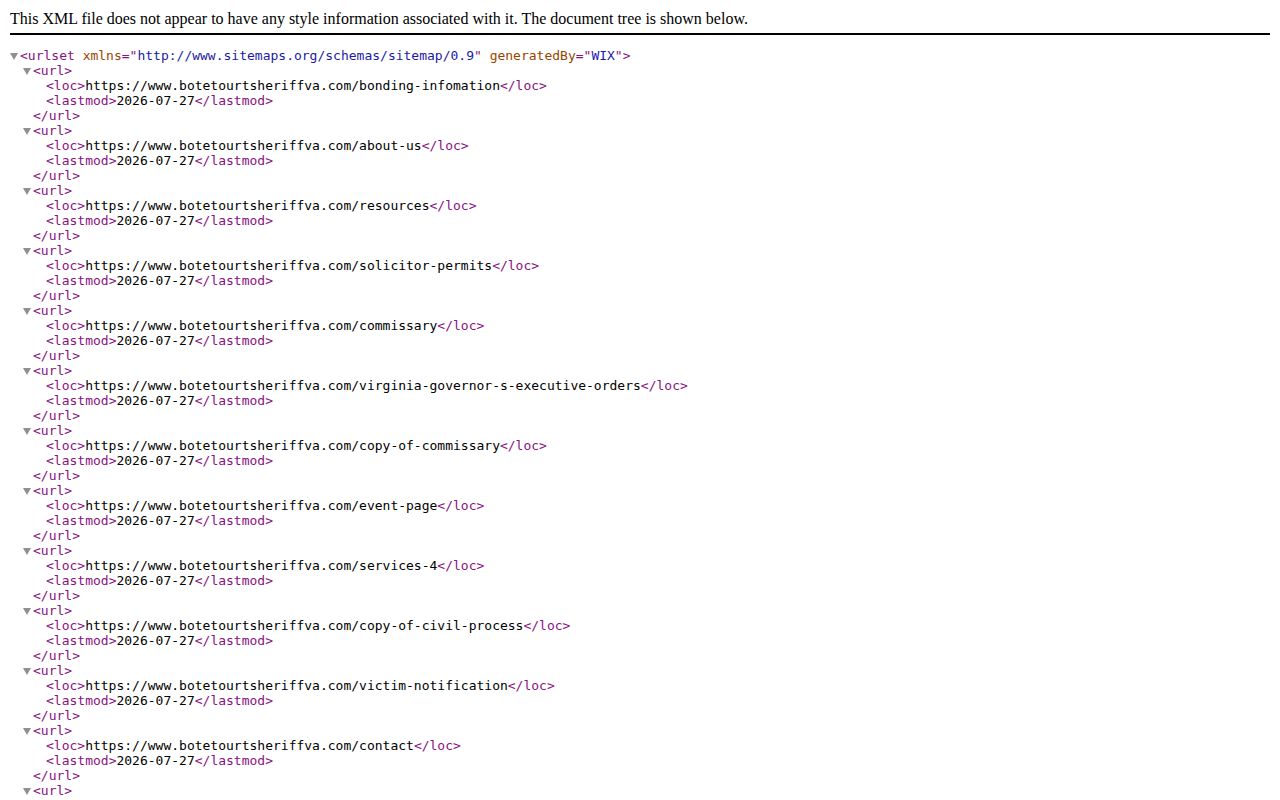
The durable record and the absent online feed are two different facts. Keeping them separate prevents false claims about cadence or completeness.
Note: GS-08 retention supports a record request; it does not create public online access or bar lawful redaction.
Botetourt Release Channel Boundaries
A three-day search may cross several systems. Virginia Jail VINE covers participating local and regional jail events. It can report release or transfer, but it is not a complete archive. VADOC's locator covers state custody, VADOC authority in some local beds, and community supervision. It updates daily but is not promised as a full history of discharged people. Court records explain bond and disposition. Federal and immigration cases use their own routes.
- Release
- The reporting facility ended its custody event; the person may enter the community or another system.
- Transfer
- One custodian handed control to another agency or facility.
- Discharge
- A sentence or correctional obligation ended under the custodian's record terminology.
- Detainer
- A request or legal hold that can change where the person goes when another custody event ends.
Use the category shown by the actual record. “Not found” is not a substitute for one of these statuses.
Note: A court disposition can support the release story, but only the custodian records the actual physical custody exit.
Verify Botetourt Release Destinations
When the regional jail says the person left, ask where the record points next. A state-responsible person may appear in the VADOC Inmate & Supervisee Locator. Someone released from prison but still on parole or probation may appear under a district office. A person sent to ICE should be checked promptly in ODLS because its released-person coverage is limited. A federal sentence calls for the BOP locator, while federal pretrial release is proved through the court order and holding facility.
VINE serves a narrower job. A matched local-jail record can show the end of the participating custody event and can send a notice. It does not prove that no transfer occurred. Botetourt's sheriff also warns that VADOC state notifications moved out of VINE. When a person enters state custody, the public locator and qualifying-victim NAAVI process become separate channels.
Court routing can span two Botetourt courts during the same three-day period. General District Court handles lower-court criminal matters and felony preliminary stages. Circuit Court handles felony trials and appeals. A release tied to bond in one docket may coexist with another active case or hold. Record each case number, disposition date, sentence, and appeal entry, then obtain the signed order from the clerk when the web summary is unclear. The order explains the legal event. The jail entry still supplies the physical departure time and identifies a transfer when that field is maintained.
The final three-day chronology should read as a chain: court or bond event, regional-jail release entry, destination check, and supervision status if applicable. That chain is more useful than any unsupported list assembled from old arrests.